

1. What Is the Qiwa Platform, and Why Is It Essential for Expatriates?
The Qiwa (قوى) platform has been launched as part of sweeping reforms to Saudi Arabia's labor market and as part of Vision 2030. Operated by the Ministry of Human Resources and Social Development (MHRSD), this electronic portal's main goal is to eliminate the dominance of intermediaries and reduce the rigidity of the conventional kafala system, ensuring an orderly, transparent, internationally-standard digital labor environment. Previously, any Bangladeshi worker had to depend entirely on the kafeel's or employer's will regarding job opportunities, kafala change, or leave matters. With the arrival of the Qiwa platform, this dependency has ended, and every expatriate's rights are now legally protected.
On the Qiwa platform, all of an expatriate's employment-related information is preserved as a digital record. When an employer hires a new worker or renews a contract with an existing worker, it must be mandatorily uploaded to the Qiwa platform. The worker logs in using their own national ID or Iqama number and the Nafath app, sees every term of the contract with their own eyes, and enjoys the sovereign right to accept or reject it.
Main services and facilities of the Qiwa platform:
Digital Work Contract: An employer's verbal promise has no basis; only a contract written and approved on Qiwa is recognized as legal documentation in Saudi labor court. Employee Transfer: Completing an application for transfer to another company without a No Objection Certificate (NOC) from the kafeel or current sponsor, subject to meeting specific legal conditions. Job title and rank verification: Correcting visa discrepancies by verifying the profession on the passport against the actual profession registered on the Qiwa portal. Experience Certificate: Collecting an automatic digital certificate without hassle at the end of a job term.
Therefore, having a personal account on the Qiwa platform and regularly checking employment status is one of the essential prerequisites of civic awareness for every Saudi expatriate. If you want to know the validity of your Iqama and the status of information on the Absher portal, you can check our detailed Saudi Iqama Check and Absher Portal Guide.
2. Steps for Qiwa Account Registration, Login, and Labor Contract Verification
To use the Qiwa platform, you must first create a personal account (Individual Account). Many think Qiwa is only for companies, which is a completely mistaken idea. There is a Business account for companies and an Individual or personal portal for expatriates.

Sequential steps to open a new account on the Qiwa portal:
Step 1: Access the official website and confirm identity
Go directly to the Qiwa.sa portal from a smartphone or computer browser. Select English or Arabic as the language and click the "Register" option. Then provide your valid 10-digit Iqama number and date of birth (per the Arabic Hijri or English Gregorian calendar).
Step 2: OTP and Nafath verification
A four-digit one-time password (OTP) will arrive at the mobile number registered on your Absher portal. Enter the code correctly. Then match the number displayed on the Nafath app screen to complete biometric confirmation.
Step 3: Create password and link email
Create a strong password that includes uppercase letters, lowercase letters, numbers, and special symbols (@, #, $). Provide your personal active email ID and confirm the account by clicking the confirmation link.
Details of Digital Work Contract verification:
Once you log in and enter the dashboard, you will see your current active contract or a contract sent by a new company. Here it is important to carefully check the following points:
Basic Salary & Allowances: Whether your basic salary, Housing Allowance, Transport allowance, and other benefits are correctly listed separately. This is because basic salary is extremely important for gratuity and overtime calculations. Contract Period: Whether the contract is fixed-term (1 year or 2 years) or indefinite-term. Fixed-term contracts are completed for the majority of expatriate workers. Probationary Period: Under Article 53 of Saudi labor law, the probationary period can be a maximum of 90 days, but it can be extended up to a maximum of 180 days with the written consent of both parties. During this time, either party can cancel the contract without notice. Notice Period: How many days in advance notice must be given if you do not wish to renew the contract (generally 60 to 90 days).
Warning: If a new employer sends you a contract offer, there is generally a maximum of 10 days (or, in some cases, a time per the notice period) to accept it on the Qiwa platform. If this deadline passes, the offer will be automatically canceled. So look at the contract in time and press the "Accept" or "Reject" button.
3. Legal Rules and Conditions for Kafala Change Without the Kafeel's Permission
Under Saudi Arabia's Labor Reform Initiative (LRI), the most groundbreaking change for expatriate workers is the establishment of the legal right to change employment without the kafeel's no-objection or permission (Tanazul without kafeel consent). In the past, it was impossible to change companies if the kafeel did not agree. Currently, if certain specific legal exceptions occur, any expatriate worker can legally transfer to another company.

Situations in which kafala can be changed without the kafeel's permission:
1. Absence of a written and digital contract:
If, after arriving in Saudi Arabia or after the old contract ends, the employer does not upload and get approval for a digital contract on the Qiwa platform, the worker can transfer to any other legal company at any time.
2. Salary unpaid for a continuous 3 months or more:
If the employer fails to pay a worker's salary for a continuous 3 months (90 days), or does not record the salary in the Wage Protection System (WPS), the worker can immediately apply for tanazul without any consent from the current kafeel.
3. Expiry of the Iqama or work permit term:
If the kafeel does not renew the Iqama within 30 days of its term ending, or if a new worker's first Iqama is not issued within 3 months of arriving in Saudi Arabia, then under Ministry of Labor rules the worker becomes free to change kafala.
4. The company's Nitaqat status becomes Red:
If the employing establishment falls into the Red category by violating the Saudi government's Saudization policy, any foreign worker at that establishment can move to a Green or Platinum category company without obstruction.
5. The kafeel filing a false Huroob (absconding) report:
If it is proven that the kafeel filed a false Huroob report out of malice, and it is dismissed after a labor court hearing, the court directly gives the worker the opportunity to transfer elsewhere.
6. Full completion of the contract term and giving notice:
If you have given notice through the Qiwa platform not to renew the contract before the scheduled end of your fixed-term contract (e.g., 60 days in advance), you can freely join a new job as soon as the contract ends.
| Situation description | Is current kafeel's permission needed? | Required evidence document | Average transfer time |
|---|---|---|---|
| Contract term ends and notice given on time | No (permission not needed) | Qiwa notice confirmation | 7 days from the day the contract ends |
| Salary unpaid for a continuous 3 months | No (permission not needed) | Bank statement and WPS data | 10 to 14 business days |
| Iqama term expired (more than 30 days) | No (permission not needed) | Absher / Muqeem Iqama status | 3 to 5 business days |
| Establishment falls under Red category | No (permission not needed) | Qiwa company Nitaqat record | Instant (online process) |
| Voluntary transfer mid-way through current contract | Yes (kafeel's digital consent mandatory) | Mutual settlement document | As soon as kafeel approves |
4. Complete Outline of a New Company's Offer and Kafala Approval on Qiwa
When you decide to join new employment, the entire transfer process is conducted through the Qiwa platform. There is no need for any paper filing or going in person to the passport office. However, this process involves legal obligations on both sides.
The detailed steps of the transfer process are presented below:
New company submits application: Your new employer will send an "Employee Transfer Request" from their Qiwa Business account using your Iqama number and date of birth. At the same time, they will create and upload a new job contract for you. Notification sent to the worker: As soon as the new company applies, an SMS will arrive at your registered mobile, and the new request will appear on your Qiwa Individual dashboard. Reading terms and digital signature: If, after logging into your Qiwa account and carefully reading the newly proposed position, salary, working hours, and benefits, you are satisfied, click the "Accept" option. This is equivalent to a digital signature. Notice period calculation: If you are under a notice period per the terms of your previous contract, the days of the notice period (generally 30 to 90 days) will begin counting on the Qiwa system. Until the notice period ends, the current kafeel can legally keep you employed. Payment of the government transfer fee: After the notice period is completed, the new employer must deposit the government kafala fee (2,000 riyal the first time, 4,000 riyal the second time, and 6,000 riyal every subsequent time) through SADAD. Completion of Iqama and kafala: After the fee is paid, your sponsorship name in the Muqeem and Absher system will change to the new company's name, and a new digital Iqama will be issued.
Tips: Throughout the entire kafala change process, make sure your Iqama does not become illegal or expired in any way, unless you have applied under the law governing expired Iqamas. To ensure the correct management of your bank account throughout, follow our Saudi Riyal Rate and Digital Banking Guide.
5. Saudi Labor Law: Working Hours, Weekly Leave, Annual Leave, and Overtime
Saudi Arabia's Royal Decree No. M/51 of 2005 and the subsequently amended Saudi Labor Law clearly define every worker's working hours, health protection, and right to rest. Unfortunately, many Bangladeshi expatriates, due to not knowing the clear provisions of the law, are deprived of fair dues even after working extra hard.

Basic rights under labor law and rules of the work environment:
1. Daily and weekly working hours (Article 98):
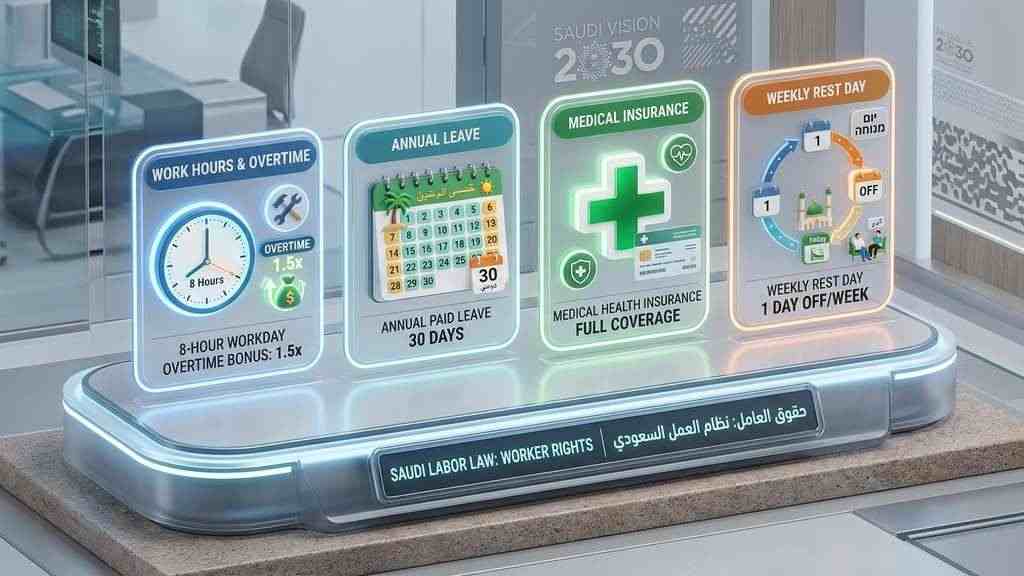
Under Saudi labor law, daily working hours on ordinary days are a maximum of 8 hours and a maximum of 48 hours per week. During the holy month of Ramadan, it is mandatory to reduce daily working hours to a maximum of 6 hours and 36 hours per week for Muslim workers.
2. Government rules for calculating overtime (Article 107):
If a worker is made to work beyond the daily 8 hours, it will be counted as extra work time or overtime. The hourly pay for overtime will be the worker's normal hourly basic pay plus an additional 50%, that is, 150% (1.5 times) of the basic pay. If work is done on Friday or the weekly holiday, the entire time will be counted as overtime.
3. Weekly leave and breaks (Articles 101 and 104):
Every worker is entitled to at least 24 continuous hours of full rest or weekly leave per week. Generally Friday is the weekly holiday, but according to the type of establishment, any other day can be set by mutual agreement. Making someone work continuously for more than 5 hours without a break is legally prohibited; at least a 30-minute prayer and meal break must be given after every 5 hours of work.
4. Annual paid leave (Article 109):
After completing one continuous year of work at the same establishment, a worker will receive at least 21 days of paid leave per year. And if the worker remains continuously employed at the same establishment for 5 years or more, their annual leave amount will mandatorily increase to 30 days. The full pay for this leave must be paid in advance.
5. Other special leaves:
Eid al-Fitr and Eid al-Adha: 4 days each for both Eids, for a total of 8 days of paid public holiday. National Day and Founding Day: Saudi National Day (September 23) and Saudi Founding Day (February 22), 1 day each of paid leave. Marriage leave: 5 days of paid leave for the worker's own marriage. Childbirth: 3 days of paid paternity leave for male workers on the birth of a child. Bereavement leave: 5 days of paid leave on the death of a spouse, parent, or child.
6. The Wage Protection System (WPS / Mudad) and Effective Strategies for Recovering Unpaid Wages
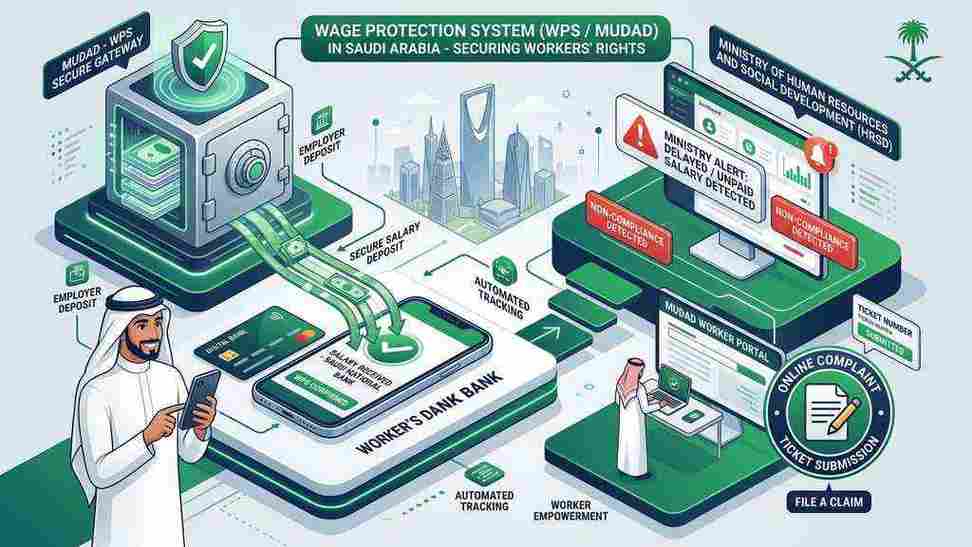
One of Saudi Arabia's most successful economic reforms is the Wage Protection System (WPS). Through this system, the government monitors every private establishment's wage payment records in real time through the Central Bank. No establishment can show wages paid in cash to workers; every worker's salary must be sent through the Mudad platform to a valid bank account or digital wallet.
What to do if the employer withholds or delays salary?
If your employer does not pay salary on the set date of the month (generally by the 7th of the next month), take the following sequential steps:
Preserve bank statement: Download the digital statement of your Saudi bank account for the past several months and keep it as a PDF, which will prove that no salary was credited. Check the Mudad portal: Go to the Mudad.com.sa website and check your pay slip using your Iqama and phone number. Verify there whether the salary is shown as paid or unpaid. Report to the ministry hotline (19911): The Saudi Ministry of Labor's official multilingual customer care number is 19911. You can call this number and request to speak in Bangla. File a complaint there with your kafeel's Commercial Registration (CR) number and your Iqama number. Online complaint on the labor website: Go to the "Labor Dispute Settlement" section through MHRSD's own mobile app or website and send a formal notice stating the amount of unpaid salary.
Important law: If a company fails to pay workers' salary for a continuous 2 months, the Ministry of Labor blocks all of that company's government services (Iqama renewal, visa issuance, etc.). And if salary is not paid for a continuous 3 months, workers automatically become eligible to get tanazul.
7. Method for Calculating End of Service Benefits, or Ikramiya (EOSB)
The biggest financial gain after a long career for expatriates in Saudi Arabia is the End of Service Benefits (EOSB), known among local Bangladeshis as "Ikramiya" or "Service Benefit." Articles 84 to 88 of Saudi labor law clarify the detailed calculation and legal right to this benefit. Receiving this money upon resigning from a job or upon the employer ending the job is the legal right of every legal worker.
The basic formula for calculating gratuity or Ikramiya (Article 84):
If the employer sends the worker off at the end of the contract (Termination or Non-renewal by Employer), the general rule for calculation is:
For the first 5 years: Half a month's pay (15 days' wages) of the worker's last basic salary (Basic Salary + Housing Allowance) for each year of service. For every subsequent year (beyond 5 years): One full month's pay (30 days' wages) of the worker's last basic salary for each year of service.
Proportion of gratuity received if the worker resigns (Resignation) (Article 85):
If a worker submits a resignation on their own during the contract or without completing the contract term, gratuity will be determined based on the total period of employment as follows:
| Length of time employed | Proportion of gratuity received due to resignation | Example (assuming last full salary is 3,000 riyal) |
|---|---|---|
| Less than 2 years | 0% (no gratuity payable) | 0 riyal |
| 2 years to less than 5 years | One-third (1/3, or 33.33%) of the total accrued gratuity | 1/3 of the 4,500 riyal total accrued over 3 years of service = 1,500 riyal |
| 5 years to less than 10 years | Two-thirds (2/3, or 66.66%) of the total accrued gratuity | 66.66% of the total amount accrued over 7 years of service |
| 10 years or more | Full 100% gratuity payable | Receives the entire amount with no deduction |
A practical, simple calculation example:
Suppose a Bangladeshi technician worked faithfully at a company in Riyadh for a continuous 7 years. His last combined basic salary and housing allowance totaled 4,000 Saudi riyal. The company is giving him a final exit at the end of the contract. So how much Ikramiya will he receive?
For the first 5 years: (5 years × 2,000 riyal) = 10,000 riyal For the next 2 years: (2 years × 4,000 riyal) = 8,000 riyal Total gratuity receivable: (10,000 + 8,000) = 18,000 Saudi riyal!
Legal obligation: Under Article 88 of Saudi labor law, after the contract ends, the employer is obligated to pay the worker's outstanding dues and gratuity within a maximum of one week. And if the worker resigns, all dues must be settled within a maximum of two weeks.
8. The Prohibition on Withholding Passports and Rules for Labor Court (Najiz Portal) Litigation
The strictest directive of Saudi Arabia's labor law and Human Rights Commission is that no employer or company can keep custody of or withhold any worker's passport. A passport is a worker's own personal international identity document and must remain entirely in the worker's own custody.

Punishment for withholding a passport:
Under Saudi royal decree, if a kafeel or owner keeps a passport against the worker's will, a complaint can be filed directly against that owner at labor court. If the offense is proven, the employer can be fined up to 20,000 Saudi riyal per worker by the government, and that establishment's work permit services are suspended. Except for a temporary need related to visa matters or Iqama renewal, the worker always has the right to keep the passport in their own pocket or cupboard.

Digital steps for filing a complaint and case at Saudi Labor Court:
If a dispute arises with the kafeel (such as not paying salary, forcing an illegal final exit, not giving the passport, or refusing to give gratuity), a case can be filed online from home without going to court in person:
Step 1: Application for amicable settlement on the Amvi (Wedya) portal
Before going directly to court in Saudi Arabia, an application must be made on the Ministry of Human Resources' Amicable Settlement platform. After the application is accepted, both parties (worker and owner) are given a specific date by the ministry to appear at an online virtual meeting. The maximum time limit for this settlement is 21 business days.
Step 2: Referral to Labor Court if no settlement is reached
If the owner does not attend the meeting within 21 days, or no dignified financial solution is reached between both parties, the mediating officer prepares a "referral report" and sends the case directly to the Ministry of Justice's Najiz (Najiz.sa) Labor Court.
Step 3: Virtual court hearing and enforcement of the ruling
After a case number is assigned on the Najiz portal, a Saudi judge hears the statements of both parties. For the worker's convenience, the court provides a free translator. Once the judge issues a ruling, that ruling is mandatorily enforced by the Saudi Enforcement Court (تنفيذ - Tanfeedh). If the owner does not pay the money, the court directly freezes their bank account and all government activities.
9. Frequently Asked Questions (FAQs)
Specific Rules and Legal Backup for Downloading the Qiwa Online Arabic Contract
For the legal security of your career in Saudi Arabia, it is extremely important to keep a PDF copy of the digital Qiwa contract saved on your smartphone. After logging into the Qiwa account, click "Contract Authentication" under "Services." There you will find a "Download Contract" button beside your active contract.
This digital contract carries the official QR code of the Saudi Ministry of Labor, which is directly acceptable as a legally valid document at any court, bank loan approval, or the Passport Directorate. If any kafeel or owner tries to force you into risky work outside the contract, or fails to pay contract-based overtime by the set date, you can show the terms of this contract to give a legal notice directly to a labor inspector. Downloading and keeping this paper safe to protect your own rights abroad is a basic self-protective right of every worker.