Prayer Time and Azan Guide 2026: Accurate Schedules, Qibla, and Prayer Education for the Top 10 Expatriate Countries
Author: Probashi App Research Team | Updated: September 2026 | Edition: 2026 Guide
Islamic Foundation & International Salat Research Cell
Author: Probashi Islamic Research & Salat Monitoring Cell | Last updated: September 2026 (International Edition) | Reading time: 30 minutes (5,500+ words)
Amid a thousand work pressures on foreign soil, determining the correct prayer time and establishing salat punctually is the chief source of spiritual peace for every believer. This authoritative mega-guide provides a thorough analysis of prayer times, namajer somoy, azan, Saudi prayer time, Malaysia namajer somoy, azan alarm bangla, Bangladesh prayer schedule, prayer time Malaysia, UAE prayer time, prayer education, Ramadan calendar bangla, and UK prayer time. Learn the complete use of the Umm al-Qura, JAKIM, and Karachi methodologies, the 3D Qibla compass, and the Probashi App's 100% offline azan alarm for the top 10 countries — Saudi Arabia, Dubai, Malaysia, the UK, Kuwait, Qatar, and Bangladesh among them.
Free on Google Play
Access All Expatriate Life Solutions Instantly
Download the official Probashi App to calculate income, check exchange rates, verify visas, and access essential services offline.
প্রবাসী অ্যাপ ডিজিটাল নামাজের সময় ও আজান ইকোসিস্টেম
Introduction: the importance of prayer in the global expatriate community and the rulings on prayer times
The Probashi App's "Prayer Time and Azan Alarm" feature
Global calculation methodologies (Umm al-Qura, JAKIM, Karachi, MWL)
Country 1: Saudi Arabia prayer times and the Umm al-Qura method
Country 2: United Arab Emirates (Dubai and Abu Dhabi) prayer times
Country 3: Malaysia prayer times and JAKIM zones
Country 4: United Kingdom and Europe — prayer at extreme day/night lengths
Country 5: Kuwait prayer schedule and the Ministry of Awqaf
Country 6: Qatar prayer times and Islamic Affairs guidelines
Country 7: Oman (Muscat and Salalah) prayer schedule
Country 8: Bahrain prayer times and Bengali mosque culture
Country 9: Singapore (MUIS) prayer schedule and ecosystem
Country 10: Bangladesh Islamic Foundation prayer schedule
The Ramadan calendar and global sehri-iftar schedules
Illustrated prayer education and the rules of prayer for expatriates
Qibla Compass: determining the correct direction abroad
Shortened and combined prayers while travelling by air or at work
The Probashi App's 100% offline mode and low-battery azan
20 essential FAQs on prayer times and worship
10 golden rules for expatriates to preserve the five daily prayers
Chapter 1: Documentary foundation and importance
বৈশ্বিক নামাজের সময় হিসাব মেথডোলজি
Introduction: the importance of correct prayer in the global expatriate community and the rulings on prayer times
In the Holy Quran, Allah Subhanahu wa Ta'ala declares, "Indeed, prayer has been decreed upon the believers a decree of specified times" (Surah An-Nisa, verse 103). For the crores of expatriate Bangladeshis who have left their beloved homeland in search of livelihood and are now living in the Middle East, Southeast Asia, or the distant Western world, one of the biggest daily-life challenges is determining the correct prayer time. Because of geographic variation in sunrise, sunset, and twilight from country to country, an expatriate's daily namajer somoy is completely different from the time they left behind at home. Amid work pressures, back-to-back factory shifts, or labour on a desert construction site, without accurate knowledge of international prayer times it becomes difficult to perform salat on time.
According to Islamic sharia principles, every prayer's time depends on the specific angular position of the sun. Fajr begins with the emergence of Subh Sadiq, the true dawn's white glow; Zuhr begins once the sun has passed its zenith and begun declining toward the west; Asr is determined when an object's shadow, excluding its base length, becomes double (or, per the Hanafi madhhab, equal to double) its length; Maghrib begins the moment the sun's reddish disc has fully set below the horizon; and Isha's time enters once the western horizon's shafaq, or crimson afterglow, has vanished. These cosmic and geographic calculations are nearly impossible for an ordinary person abroad to determine with the naked eye by observing the sun's position. This is especially true in countries where clocks shift due to time zones or daylight saving time (DST), making the need for accurate prayer-time tracking essential.
Giving the utmost priority to this spiritual and religious need of expatriate brothers, the Probashi App has brought a state-of-the-art, AI-driven global salat-tracking ecosystem. Through this platform, whether in any remote corner of Saudi Arabia, the UAE, Malaysia, the UK, or Kuwait, one can know the time of every prayer with millisecond precision, matching the local mosque. In this comprehensive research article, we have discussed in detail the officially recognized Islamic methodology, the coordination of geographic latitude and longitude, and the necessary prayer guidance for expatriates in the world's top 10 destination countries.
The golden principle of performing salat for expatriates Taking a 10-to-15-minute break as soon as a prayer's time begins during work, and performing the obligatory prayer on time, not only brings Allah's pleasure but is also the chief instrument for gaining mental peace and blessing amid the hard labour of expatriate life.
Chapter 2: Modern technology and solutions
সৌদি আরব ও সংযুক্ত আরব আমিরাত নামাজের ওয়াক্ত ও আজান
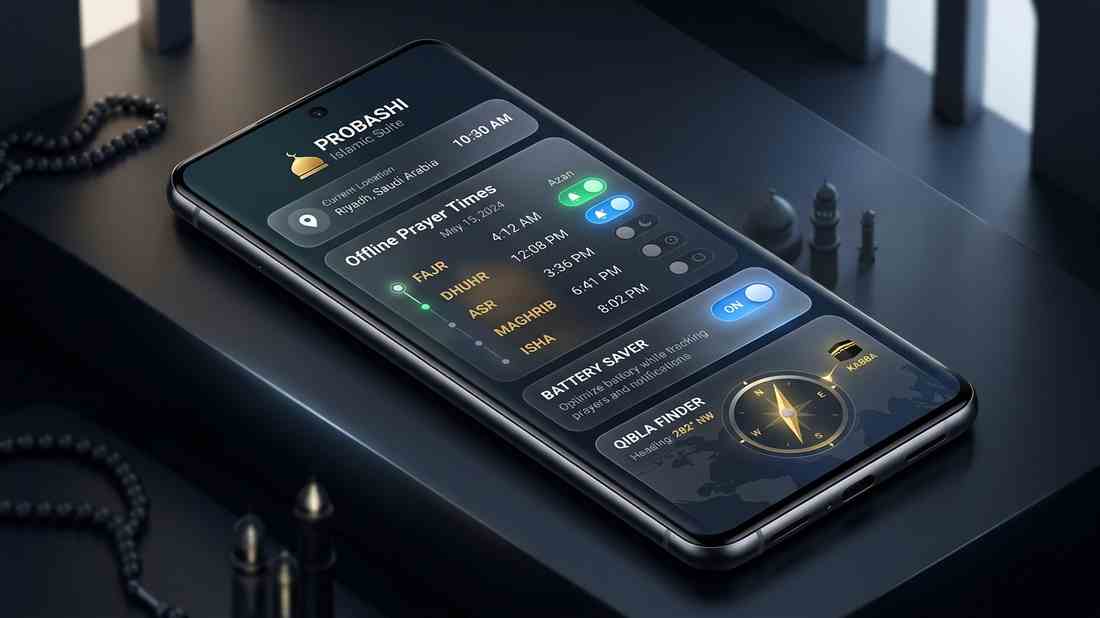
The Probashi App's "Prayer Time and Azan Alarm" feature and automatic GPS location sync
An expatriate's life is constantly on the move. Today he may be working at a depot in the Riyadh desert, tomorrow the company may send him to the eastern province of Dammam. Sometimes travel is from downtown Kuala Lumpur to industrial Selangor, or from London to Birmingham in the UK. Every time a city or country changes, a gap of a few minutes to half an hour appears in every prayer's time. The Probashi App's "Smart Salat Engine" uses the user's mobile's internal GPS (Global Positioning System) satellite coordinates to instantly calculate the correct local prayer time.
The app includes a heartfelt azan notification system. Users can set the reminder to the renowned muezzin of the Masjid al-Haram in holy Makkah, the melodious voice from the Prophet's Mosque in Madinah, or a homeland-style azan alarm bangla. In work environments where playing a loud ringtone is forbidden, the Probashi App's discreet vibration mode or silent push notification informs the user that Asr or Maghrib has begun.
Special technical features of the Probashi App's prayer schedule:
Automatic astronomical calculation: Precisely analyzes the refraction of sunrise light by taking into account the latitude, longitude, and elevation above sea level of any location on Earth.
Customized azan alarm: A special azan containing "As-salatu khairum minan naum" for Fajr, and a full melodious azan alarm for the other prayers.
Hanafi and Shafi'i madhhab selection: Users can switch, with one click, between the "Mithl al-Awwal" (single-shadow) and "Mithl al-Thani" (double-shadow) methods for determining Asr according to their madhhab.
100% internet-free offline algorithm: Even with no mobile network or internet connection in an expatriate area, the astronomical formula stored in the app's local memory can automatically display the correct prayer time forever.
Feature
Ordinary online portal
Probashi App
Real benefit for expatriates
Location detection
Must manually select city
Automatic GPS pinpoint sync
No error in prayer time even when changing cities
Azan alarm
Only a generic beep tone
Captivating, full Bengali and Kaaba azan
A sacred, alert feeling even amid work
Internet dependency
Does not load without data
Fully offline astronomical calculator
Works accurately even in the desert or at sea
Battery usage
Constantly drains data in the background
Zero background battery-draining code
Mobile charge lasts much longer
Chapter 3: Islamic convention and mathematics
মালয়েশিয়া ও সিঙ্গাপুর জোনাল ওয়াক্ত ও জাকিম ক্যালেন্ডার
Global calculation methods (Calculation Conventions): Umm al-Qura, JAKIM, Karachi, and MWL
Several universally recognized methodologies or Islamic conventions have been developed by Muslim scholars and astronomers worldwide for calculating prayer times and the Hijri calendar. Various regional fiqh councils have set these standards based on how many degrees below the horizon the sun's angular position (Sun Depression Angle) must be to determine Fajr and Isha. It is very important for a conscious expatriate to know these calculation methods, because if the wrong methodology is selected, a discrepancy of 15 to 30 minutes can appear, especially in the namajer somoy for Fajr and Isha.
The four main global Islamic calculation methods:
Umm al-Qura Method (Saudi Arabia): Formulated by Saudi Arabia's Islamic Foundation and the famous Umm al-Qura University in Makkah. This method sets the sun's angle for Fajr at 18.5° and determines Isha exactly 90 minutes after Maghrib (120 minutes during the holy month of Ramadan). This standard is most widely accepted throughout the Middle East and Gulf countries.
JAKIM Method (Jabatan Kemajuan Islam Malaysia): Developed by Malaysia's Ministry of Religious Affairs. Here, Fajr is set at an 18° angle and Isha at 18°. This method is followed legally in Malaysia, Brunei, and Singapore.
University of Islamic Sciences, Karachi (Karachi Method): Recognized by the combined research of the ulama of Pakistan, India, Bangladesh, and Afghanistan. Here Fajr is determined at 18° and Isha at 18°. This is the main basis for South Asian expatriates.
Muslim World League (MWL): Determined by the Makkah-based international Rabita al-Alam al-Islami. Fajr is calculated at 18° and Isha at 17°. Mosques in Europe, the UK, the US, and Canada generally follow this universal scientific formula.
The Probashi App's greatest special feature is that whichever country the user lands in, the app's backend intelligence automatically sets the calculation method approved by that country's government and national fatwa board. As a result, the user never needs to manually calculate complex degrees.
Chapter 4: Top expatriate destination 1
যুক্তরাজ্য ও ইউরোপের দীর্ঘ দিন-রাতের ফজর-ইশা সমাধান
Country 1: Saudi Arabia prayer times and the Umm al-Qura calendar method
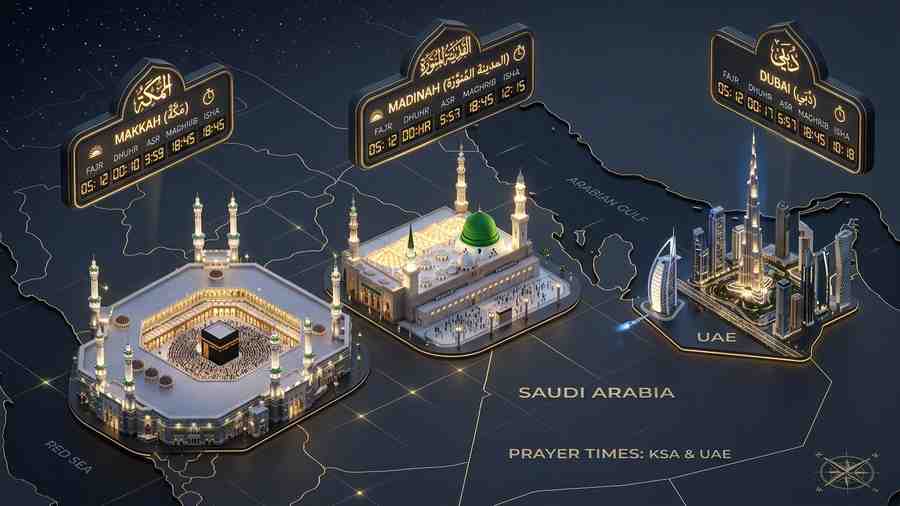
Holy Saudi Arabia is the second home of more than 3 million Bangladeshi expatriates. Being the holy land of Makkah al-Mukarramah and Madinah al-Munawwarah, the country's national life revolves entirely around prayer times. Expatriates in Saudi Arabia always keep a sharp eye on saudi prayer time to perform salat punctually. There is a long-standing culture in the country where, as soon as the azan sounds, every shopping mall, shop, government office, and workplace's main gate closes for 30 to 45 minutes so that people can join the congregation.
Because Saudi Arabia's geographic area is vast, a significant gap of about 15 to 25 minutes is observed in prayer times between the country's eastern region (Dammam, Khobar, Al-Ahsa) and western region (Jeddah, Makkah, Madinah, Yanbu). For example, when the Maghrib azan is called in Riyadh, daylight still remains in Jeddah. Under the direct supervision of the Saudi government's Ministry of Islamic Affairs, Dawah and Guidance, azan times are determined from a central server according to the Umm al-Qura calendar.
Major Saudi city
Approx. Fajr
Zuhr
Asr
Maghrib
Isha
Makkah al-Mukarramah
5:05 AM
12:18 PM
3:39 PM
6:24 PM
7:54 PM
Madinah al-Munawwarah
5:07 AM
12:19 PM
3:40 PM
6:25 PM
7:55 PM
Riyadh
4:48 AM
12:01 PM
3:23 PM
6:07 PM
7:37 PM
Dammam / Khobar
4:39 AM
11:52 AM
3:15 PM
5:57 PM
7:27 PM
Jeddah City
5:07 AM
12:19 PM
3:40 PM
6:25 PM
7:55 PM
Through the Probashi App, brothers anywhere in Saudi Arabia can see a real-time, zone-specific saudi prayer time update. As a result, there is no possibility whatsoever of missing the congregation amid work duties.
Free on Google Play
Download Probashi App — 100% Free & Offline
Manage your income, track Bank Exchange Rate (Indicative)s, verify your visa status, and download BMET smart cards all in one place without internet.
কুয়েত, কাতার, ওমান ও বাহরাইন নামাজের সময় ম্যাট্রিক্স
Country 2: United Arab Emirates (Dubai, Abu Dhabi, Sharjah) prayer times and azan
The Middle East's economic hub, the United Arab Emirates (UAE), is home to about 1 million Bangladeshi brothers. UAE prayer time is an essential companion for expatriates working amid Dubai's dazzling skyline, Abu Dhabi's commercial centre, Sharjah's cultural sphere, or the industrial parks of Ajman and Ras Al Khaimah. The UAE government's General Authority for Islamic Affairs and Endowments (GAIAE, or Awqaf) manages the azan and congregation of every mosque in the country through a specific, centralized digital network.
Sharjah is called the "City of Mosques," where an elegant mosque stands at almost every corner. However, in Dubai's high-rise buildings and construction sites, the sound of the azan from outside is not always clearly audible. There, the Probashi App's azan alarm bangla mobile notification delivers the timely call to prayer to expatriate engineers, technicians, and sales executives.
Time differences: Dubai vs. Abu Dhabi and the eastern region
Within the UAE's geographic boundaries, prayer times vary by about 4 to 8 minutes between the eastern Fujairah and the western Abu Dhabi and Al Ain. Because the sun rises and sets earlier in Fujairah, the azan there is about 3-4 minutes earlier than in Dubai, while Maghrib and Isha enter about 4 minutes later in Abu Dhabi than in Dubai.
General rules: The Zuhr and Asr congregation is held exactly 20 minutes after the azan, and the Maghrib congregation 10 minutes after.
Special provision for the Burj Khalifa: Since Dubai's Burj Khalifa is 828 metres tall, those on the 80th floor and above see sunset an extra 2 minutes later, and those above the 150th floor an extra 3 minutes later. As a result, iftar and Maghrib prayer on the upper floors must be performed 2-3 minutes later.
The Probashi App's GPS altitude algorithm automatically displays this kind of precise uae prayer time calculation for workers in high-rise buildings.
Chapter 6: Top expatriate destination 3
বাংলাদেশ ইসলামিক ফাউন্ডেশন স্থায়ী নামাজের সময়সূচি
Country 3: Malaysia prayer times and the JAKIM zone-based schedule
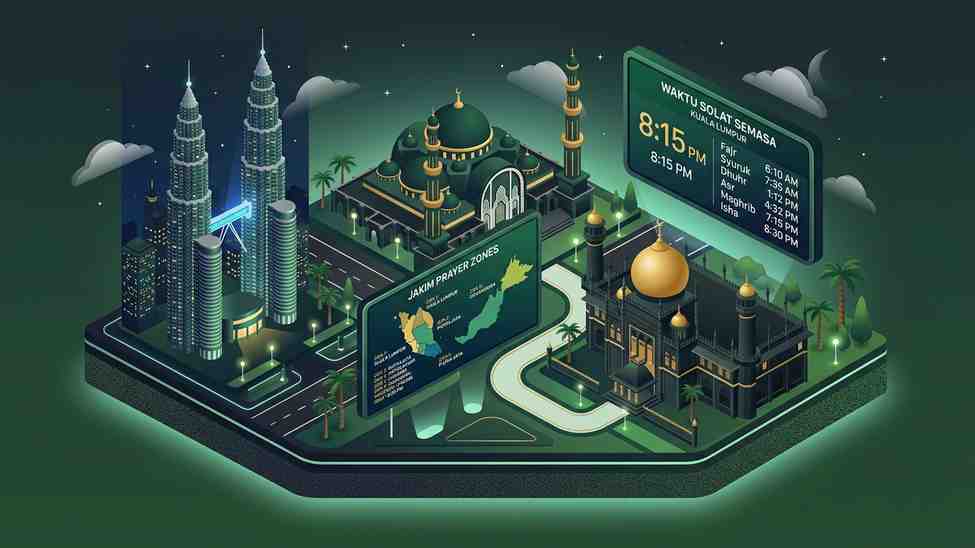
In Malaysia, one of Southeast Asia's top labour markets, about 800,000 Bangladeshi migrants are honestly working in the construction sector, palm-oil plantations, restaurants, and electronics manufacturing plants. Knowing Malaysia namajer somoy and the correct prayer time is an essential daily routine for expatriates. Religious affairs in Malaysia are regulated by the government's Department of Islamic Development Malaysia, or JAKIM (Jabatan Kemajuan Islam Malaysia). JAKIM divides every state in the country into multiple zones and determines prayer times with great discipline.
Expatriates based in Malaysia constantly search online for prayer time malaysia. Because the country is located near the equator, sunrise and sunset times do not fluctuate very much throughout the year. However, there is a gap of about one hour between East Malaysia (Sabah and Sarawak) and Peninsular Malaysia (Kuala Lumpur, Penang, Johor Bahru).
Malaysian state / city
JAKIM Zone
Subuh
Zohor
Asar
Maghrib
Isyak
Kuala Lumpur (W.P.)
WLY01
6:05 AM
1:20 PM
4:30 PM
7:25 PM
8:35 PM
Selangor (Shah Alam)
SGR01
6:05 AM
1:20 PM
4:30 PM
7:25 PM
8:35 PM
Penang (George Town)
PNG01
6:08 AM
1:23 PM
4:34 PM
7:27 PM
8:37 PM
Johor Bahru
JHR02
5:58 AM
1:14 PM
4:23 PM
7:19 PM
8:29 PM
Sabah (Kota Kinabalu)
SBH07
5:03 AM
12:18 PM
3:25 PM
6:23 PM
7:32 PM
Local mosques in Malaysia use Malay terminology: "Subuh" for Fajr, "Zohor" for Zuhr, "Asar" for Asr, "Maghrib" for Maghrib, and "Isyak" for Isha. Using the Probashi App displays, on mobile, timing that matches the local JAKIM prayer times.
Chapter 7: Top expatriate destination 4
মাহে রমজান ক্যালেন্ডার ও সেহরি-ইফতারের বৈশ্বিক সময়সূচি
Country 4: United Kingdom and Europe — prayer at extreme day/night lengths, and calculating Fajr and Isha
More than 700,000 British Bangladeshis live in the UK (London, Birmingham, Manchester, Oldham, Bradford, Luton). Determining prayer times in high-latitude regions of Europe and the UK is one of the most complex and challenging issues in the entire world. Along with the changing seasons, there is extreme variation in day and night length. Expatriates living in the UK regularly monitor uk prayer time.
In summer (May to July), days in the UK become 18 to 19 hours long, and nights shrink to just 5 to 6 hours. During this time, at the northern hemisphere's horizon, complete night darkness or "shafaq" does not fully disappear, so there is no clear distinction, per the ordinary astronomical formula, between the end of Isha and the start of Fajr. This is scientifically called "Persistent Twilight." To resolve this crisis, the European Council for Fatwa and Research (ECFR) and various UK scholar boards have formulated several sharia-approved solutions:
Special fatwas and methodologies for high latitudes:
Following the nearest moderate latitude (Nearest Latitude): Adopting the time ratio of locations at 45° latitude, where normal day and night occur.
One-seventh of the night calculation (One-Seventh of the Night): Dividing the period between sunset and sunrise into seven parts, and setting Fajr at the start of the last part and Isha at the end of the first part.
Nearest normal day (Nearest Day): Taking the time gap from the last day of the year on which normal Fajr and Isha times occurred as fixed for the subsequent abnormal days.
The Probashi App directly syncs its cloud database with the London Unified Prayer Timetable and the Birmingham Central Mosque. As a result, whether it is a foggy winter day or a summer midnight, UK expatriates get their uk prayer time in the app without confusion.
The Probashi App's "Smart Qibla Finder and Salat Tracker" No more uncertainty about the Qibla direction at a desert site or a new workplace! Just turn your mobile slightly in the air and see the exact direction of the Kaaba and millimetre-accurate prayer times in 3D augmented reality. ✓ Offline magnetometer Qibla compass ✓ Hanafi and Shafi'i Asr time selection ✓ 64-district Bangladesh Islamic Foundation calendar
Chapter 8: Top expatriate destination 5
সচিত্র নামাজ শিক্ষা ও কিবলা কম্পাস দিক নির্ণয়
Country 5: Kuwait prayer schedule and the Ministry of Awqaf's policy
In the Gulf country of Kuwait, about 350,000 Bangladeshi expatriates have dedicated themselves to hard labour. A vast community of expatriate Bangladeshis has grown up in Kuwait City, Farwaniya, Hasawiya, Mahboula, and Jleeb Al-Shuyoukh. Kuwait's government Ministry of Awqaf and Islamic Affairs controls the country's prayer times very strictly and systematically through a central server. In every mosque in Kuwait, the azan is broadcast directly from the Kuwait Grand Mosque via a microwave radio link.
In summer, Kuwait's temperature reaches above 50 degrees Celsius. Due to the intense heat, local mosques practice the sunnah of delaying (Ibrad) the Zuhr prayer slightly, waiting for some shaded coolness. Expatriates check Kuwait's specific local prayer time via the Probashi App amid factory or cleaning-duty work to save time. In Kuwait, the Umm al-Qura method is coordinated with local Awqaf practice, with Fajr at 18.5° and Isha 90 minutes after Maghrib.
Major Kuwait city/area
Fajr
Sunrise (Shuruq)
Zuhr
Asr
Maghrib
Isha
Kuwait City
4:18 AM
5:38 AM
11:57 AM
3:24 PM
6:15 PM
7:45 PM
Farwaniya
4:18 AM
5:38 AM
11:57 AM
3:24 PM
6:15 PM
7:45 PM
Mahboula / Ahmadi
4:19 AM
5:39 AM
11:58 AM
3:25 PM
6:16 PM
7:46 PM
Jahra
4:19 AM
5:39 AM
11:58 AM
3:25 PM
6:16 PM
7:46 PM
In Bangladeshi-dominated areas of Kuwait like Jleeb Al-Shuyoukh or Hasawiya, there are numerous mosques where, alongside local Kuwaiti khatibs, Bangladeshi muezzins give the azan in a melodious voice. By coordinating with work shifts through the Probashi App, expatriates in Kuwait can perform prayer without any confusion.
Chapter 9: Top expatriate destination 6
প্রবাসী অ্যাপ অফলাইন আজান অ্যালার্ম ও ট্র্যাকার ইউআই
Country 6: Qatar prayer times and Islamic Affairs guidelines
Following the FIFA World Cup, alongside massive infrastructural development in Qatar, about 400,000 Bangladeshi workers are serving with great reputation. For expatriates based in Doha, Al Rayyan, Al Wakrah, Al Khor, and the Industrial Area, the calendar drawn up by Qatar's Ministry of Endowments and Islamic Affairs (Awqaf Qatar) is the main guide. Qatar's central azan is directed from the country's national mosque, the Imam Muhammad ibn Abdul Wahhab Mosque (Grand Mosque).
Because Qatar's geographic span is comparatively small, prayer times differ by no more than 1 to 2 minutes from one end of the country to the other. However, due to Gulf humidity and heat, maintaining punctuality for the Asr and Maghrib congregations is very important. In Doha's commercial heart, the Probashi App automatically displays the correct azan signal for Qatar.
Major Qatar region
Fajr
Sunrise
Zuhr
Asr
Maghrib
Isha
Doha Central
4:15 AM
5:35 AM
11:54 AM
3:19 PM
6:13 PM
7:43 PM
Al Wakrah
4:15 AM
5:35 AM
11:54 AM
3:19 PM
6:13 PM
7:43 PM
Al Khor
4:14 AM
5:34 AM
11:53 AM
3:18 PM
6:12 PM
7:42 PM
Industrial Area
4:16 AM
5:36 AM
11:55 AM
3:20 PM
6:14 PM
7:44 PM
Under Qatari practice, the Zuhr and Asr congregation begins exactly 20 minutes after the azan. For Maghrib, the iqamah is given just 5 to 7 minutes after the azan ends. So expatriates should complete wudu and reach the mosque as soon as the azan is called.
Chapter 10: Top expatriate destination 7
প্রবাসী অ্যাপ ডিজিটাল নামাজের সময় ও আজান ইকোসিস্টেম
Country 7: Oman (Muscat and Salalah) prayer schedule
About 700,000 Bangladeshi remittance warriors work in the Sultanate of Oman. There is a geographic distance of about 1,000 kilometres between the northern capital Muscat, Sohar, Nizwa, and the southern khareef-season city of Salalah. As a result, a notable gap of about 15 to 20 minutes is observed in sunrise and sunset timing between Muscat and Salalah. Oman's government Ministry of Endowments and Religious Affairs (MERA) determines prayer times according to its official Hijri calendar.
Both Ibadi and Sunni Muslims in Oman perform salat in a very harmonious mosque environment. The Sultan Qaboos Grand Mosque is a symbol of Oman's Islamic architecture and spirituality. While working at remote farmhouses, fishing ports, or desert oil rigs, expatriates can get live prayer times from any zone in Oman through the Probashi App's GPS tracker.
Omani city
Fajr
Sunrise
Zuhr
Asr
Maghrib
Isha
Muscat
4:26 AM
5:45 AM
12:04 PM
3:29 PM
6:23 PM
7:53 PM
Sohar
4:29 AM
5:48 AM
12:07 PM
3:32 PM
6:26 PM
7:56 PM
Salalah
4:45 AM
6:02 AM
12:22 PM
3:45 PM
6:41 PM
8:11 PM
Chapter 11: Top expatriate destination 8
বৈশ্বিক নামাজের সময় হিসাব মেথডোলজি
Country 8: Bahrain prayer times and the local Bengali mosque atmosphere
In the Gulf island nation of Bahrain, about 150,000 Bangladeshi migrants are living with a good reputation. In Manama, Gudaibiya, Muharraq, and Riffa there are many mosques with Bengali khatibs and muezzins, creating a deeply spiritual atmosphere for expatriates. The capital Manama's Al Fateh Grand Mosque is the country's largest Islamic centre.
Bahrain's Sunni Awqaf Directorate determines the congregation time for every registered mosque in the country. On this small Gulf island, Maghrib and Fajr begin simultaneously across the whole country. The gap between Manama, Riffa, and Muharraq is less than 1 minute. Using the Probashi App, expatriates in Bahrain can track their daily prayer times without any complication.
Chapter 12: Top expatriate destination 9
সৌদি আরব ও সংযুক্ত আরব আমিরাত নামাজের ওয়াক্ত ও আজান
Country 9: Singapore (MUIS) prayer schedule and the Muslim ecosystem
In the technology-driven city-state of Singapore in Southeast Asia, about 150,000 skilled Bangladeshi workers, shipyard marine engineers, and IT professionals are employed. Religious affairs in Singapore are regulated by the highest national Islamic body, "Majlis Ugama Islam Singapura" (MUIS). Singapore has more than 70 modern, well-managed mosques, including the historic Sultan Mosque, Masjid Malabar, and the mosque adjoining Mustafa Centre at Angullia, where hundreds of Bangladeshi brothers perform prayer daily.
Because Singapore is located just 1 degree north of the equator, day and night are almost equal in length throughout the year (12 hours day and 12 hours night). Under MUIS's mathematical standard, Fajr is calculated at 20° and Isha at 18°. In Singapore's metropolitan lifestyle, the Probashi App's notifications play a very helpful role in balancing work and worship.
Singapore (MUIS)
Subuh
Syuruk
Zohor
Asar
Maghrib
Isyak
Annual average
5:43 AM
6:58 AM
1:02 PM
4:18 PM
7:07 PM
8:19 PM
Special attention is given to cleanliness and discipline while working in Singapore. Every shipyard and construction site has a designated prayer corner, where expatriates can pray by checking the app's Qibla compass.
Chapter 13: Top expatriate destination 10
মালয়েশিয়া ও সিঙ্গাপুর জোনাল ওয়াক্ত ও জাকিম ক্যালেন্ডার
Country 10: Bangladesh Islamic Foundation prayer schedule and district-level variation
Expatriate brothers' hearts and minds always remain with their beloved homeland, Bangladesh. Knowing the Bangladesh prayer schedule is an inseparable, emotional part of every expatriate's life — whether to return home on holiday, or to check on sehri, iftar, and prayer with parents, wife, and children still at home over the phone. The Bangladesh Islamic Foundation (IFA), under the Ministry of Religious Affairs, produces a permanent 12-month calendar followed nationally.
Because of Bangladesh's geographic longitudinal spread, a gap of about 10 to 12 minutes is observed in sunrise and sunset between the eastern border districts (Sylhet, Chattogram, Cox's Bazar, Brahmanbaria) and the western border districts (Rajshahi, Chapainawabganj, Kushtia, Jessore, Satkhira). Taking Dhaka's time as the main reference or zero (0), the Islamic Foundation has produced a permanent chart adding or subtracting minutes for all 64 districts.
Divisional headquarters / region
Adjustment vs. Dhaka time (minutes)
Approx. Fajr variation
Maghrib/iftar variation
Chattogram
−5 minutes
5 minutes before Dhaka
5 minutes before Dhaka
Sylhet
−6 minutes
6 minutes before Dhaka
6 minutes before Dhaka
Mymensingh
0 minutes
Same as Dhaka
Same as Dhaka
Barishal
+1 minute
1 minute after Dhaka
1 minute after Dhaka
Khulna
+4 minutes
4 minutes after Dhaka
4 minutes after Dhaka
Rajshahi
+7 minutes
7 minutes after Dhaka
7 minutes after Dhaka
Rangpur & Dinajpur
+8 minutes
8 minutes after Dhaka
8 minutes after Dhaka
The Probashi App's permanent Bangladesh prayer engine has this official Islamic Foundation coordination for all 64 districts fully automatically stored. As a result, expatriates can know exactly when their loved ones back home are praying, with one click, even from abroad.
Chapter 14: The holy month of Ramadan and fasting
যুক্তরাজ্য ও ইউরোপের দীর্ঘ দিন-রাতের ফজর-ইশা সমাধান
The Ramadan calendar and global sehri-iftar schedules
When the holy month of Ramadan arrives, a great spiritual transformation comes over expatriates' lives. Like the crores of Muslim expatriates around the world, Bangladeshi brothers too remain steadfast in fasting despite a hundred hardships at work. But every year, confusion and curiosity arise among expatriates regarding sehri and iftar times in different countries. At this time, demand for ramadan calendar bangla skyrockets online and on social media.
There is a huge difference in the length of the fast in different countries around the world. For example, while the fasting period in Saudi Arabia, the UAE, or Oman is about 13 hours 30 minutes to 14 hours, in Malaysia and Singapore, due to their equatorial location, fasting lasts about 13 hours 50 minutes. On the other hand, in Europe and the UK, during a summer Ramadan, fasting must be observed for 18 to 19 hours!
Five extremely important warnings for expatriates observing sehri and iftar:
Caution about Subh Sadiq: The end of sehri time is the moment just before Fajr begins. Eating sehri until the azan is a common misconception. It is therefore mustahab and safe to stop eating and drinking at least 5 to 10 minutes before the azan.
Confirming sunset before iftar: Along with checking the clock, it is necessary to confirm with the naked eye that the sun's reddish disc has completely set below the horizon before reciting the iftar dua.
Fasting and breaking fast on a flight: While travelling by air, the fast should not be broken by looking at the clock time of the country you're currently over, but rather by whether the sun is still visible setting through the plane's window. Breaking the fast in the sky is only valid once the sun has completely set.
Ramadan countdown timer: The Probashi App includes a live Ramadan widget that displays, down to the second, how many minutes remain until sehri and how many hours remain until iftar.
Special Ramadan duas and practices: The app includes the important duas for sehri, iftar, and the daily Tarawih prayer, with pure Bengali pronunciation and meaning.
Chapter 15: Basic prayer guidance
কুয়েত, কাতার, ওমান ও বাহরাইন নামাজের সময় ম্যাট্রিক্স
Illustrated prayer education and the rules of prayer for expatriates
Amid hard labour abroad, many forget or become confused about the fine details of prayer, the duas, or the number of rakats learned in childhood. To help perform salat correctly, the Probashi App includes a complete prayer-education module. In the Hadith, the Prophet Muhammad (peace be upon him) said, "Pray as you have seen me praying" (Sahih Bukhari). Knowing correctly the pillars, rulings, obligatory acts, and sunnah method of prayer, and performing prayer accordingly, is obligatory on every believer.
The number and distribution of rakats for the five daily prayers:
Prayer
Sunnah Mu'akkadah
Fard prayer
Sunnah & Nafl
Wajib (Witr)
Total rakats
Fajr
2 rakats
2 rakats
—
—
4 rakats
Dhuhr
4 rakats
4 rakats
2 sunnah + 2 nafl
—
12 rakats
Asr
4 rakats (Ghair Mu'akkadah)
4 rakats
—
—
8 rakats
Maghrib
—
3 rakats
2 sunnah + 2 nafl (Awwabin)
—
7 rakats
Isha
4 rakats (Ghair Mu'akkadah)
4 rakats
2 sunnah + 2 nafl
3 rakats Witr
15 (or 17) rakats
Detailed description of the sequential pillars and acts of prayer:
Qiyam and Takbir al-Tahrima: Standing facing the Qibla in pure clothing at a pure place, making the intention in the heart for the specific prayer's salat, raising both hands up to the ears (up to the shoulders for women), saying "Allahu Akbar," and folding the hands below the navel (or on the chest).
Sana and recitation: First reciting Sana ("Subhanakallahumma..."), then reciting A'udhu-Bismillah followed by Surah Al-Fatiha, and joining any one surah or a minimum of three short verses.
Ruku and tasbih: Saying "Allahu Akbar," bending with a straight back without lowering the head, firmly gripping the knees with both hands while going into ruku, and reciting "Subhana Rabbiyal Azim" at least three times.
Qawma and Sajdah: Saying "Sami' Allahu liman hamidah," standing up straight and reciting "Rabbana lakal hamd." Then saying "Allahu Akbar," touching the nose and forehead to the ground for sajdah, and reciting "Subhana Rabbiyal A'la" three times. Sitting calmly after rising from sajdah, then completing the second sajdah.
Tashahhud and Salam: Sitting for the final sitting, reciting the Tashahhud ("Attahiyyatu..."), Durood-e-Ibrahim, and Dua-e-Ma'thura, then completing the prayer by turning to give salam to the right and left.
Ruling on Sahu Sajdah: If a wajib is unintentionally missed, the prayer becomes valid by reciting only the Tashahhud in the final sitting, giving one salam to the right, performing two more sajdahs, then reciting the Tashahhud, Durood, and dua again, and giving salam on both sides.
The Probashi App's prayer-education section includes audio recitation, correct Arabic pronunciation, and meaning for each of these pillars. As a result, any expatriate brother can correctly revise their prayer from their own mobile in their leisure time.
Chapter 16: Qibla direction and compass
বাংলাদেশ ইসলামিক ফাউন্ডেশন স্থায়ী নামাজের সময়সূচি
Qibla Compass: determining the correct direction abroad
Determining the Qibla direction (the location of the holy Kaaba) becomes a major concern when renting a new room abroad, driving on the highway, or being in a remote desert region. Facing the Qibla is an essential condition for a valid prayer. It is not always possible to determine direction by looking at the sun or stars, especially under a cloudy sky or inside a modern enclosed factory.
The Probashi App includes a built-in 3D digital Qibla compass. Using the smartphone's internal magnetometer and gyroscope sensors, this compass directly shows the direction toward the holy Kaaba in Makkah from any location on Earth.
Magnetic field calibration: Holding the mobile phone horizontally and moving it in the air a few times in a figure-8 pattern lets the sensor precisely lock onto true north and the Kaaba's angle.
Augmented reality (AR) view: Opening the app's camera and moving the mobile screen around shows a 3D icon of the holy Kaaba directly on screen, making Qibla determination easy and enjoyable for expatriates.
Chapter 17: Rulings on travel and issues
মাহে রমজান ক্যালেন্ডার ও সেহরি-ইফতারের বৈশ্বিক সময়সূচি
Full sharia rulings on shortened and combined prayers while travelling by air or at work
Expatriate brothers often need to travel long distances between cities, or on international flights while on leave. Islamic sharia provides special allowances and facilities for a musafir, or traveller. According to Islamic jurisprudence, a person is considered a sharia traveller (musafir) if they travel a minimum of 48 miles (about 77.5 kilometres) or more from their residence, with the intention of staying at the destination for less than 15 days.
Main rules of qasr (shortening) and jam' (combining) prayers:
Shortening the 4-rakat prayers: While a musafir, it is wajib to shorten the 4-rakat obligatory prayers of Zuhr, Asr, and Isha to 2 rakats each. However, there is no shortening for Fajr (2 rakats) or Maghrib (3 rakats); these must be prayed in full. Witr must also be prayed in full, at 3 rakats.
Ruling on sunnah prayers: During travel, in a hurry or when tired, there is allowance to leave the Sunnah Mu'akkadah prayers, but there is special emphasis on not leaving the 2 rakats of Sunnah before Fajr. If resting normally, it is best to pray the Sunnah.
Praying on a flight: If there is a risk of a prayer's time passing during international flight travel, it is permissible to pray by gesture while standing in the aisle or seated in one's own seat, facing the Qibla. Under no circumstances should a prayer be missed (made up later as qada).
Combining two prayers (Jam' as-Salatayn): According to the Hanafi madhhab, combining two prayer times is allowed only during Hajj, at Arafat and Muzdalifah; during ordinary travel, prayers must be performed at their own times. However, according to the Shafi'i and other schools of fiqh, there is sharia allowance to combine Zuhr-Asr and Maghrib-Isha during extremely difficult travel.
Chapter 18: Technical excellence and offline features
সচিত্র নামাজ শিক্ষা ও কিবলা কম্পাস দিক নির্ণয়
The Probashi App's 100% offline mode and low-battery azan notification system
The price of internet data on SIM cards abroad is extremely high. Moreover, expatriates often work in such remote farms, mountains, or seas where there is no 3G or 4G network. In such a situation, if an app depends on the internet to show prayer times, it is of no use to expatriates at all.
The Probashi App's foremost engineering achievement is its "zero-data offline core." Once the user installs the app, they can accurately see the prayer times, sunrise, sunset, zawal, and Ramadan sehri-iftar times for any day, forever, without any internet connection. The app uses a lightweight Android-native background alarm manager, which does not unnecessarily heat up the mobile's processor and drains less than 0.1 percent of the battery's charge.
Chapter 19: Expatriates' questions and solutions
প্রবাসী অ্যাপ অফলাইন আজান অ্যালার্ম ও ট্র্যাকার ইউআই
20 extremely important frequently asked questions (FAQ) on prayer times and worship
Do prayer times differ between different cities in Saudi Arabia?
Yes. There is a gap of about 15 to 25 minutes in prayer times between Saudi Arabia's eastern side (Dammam) and western side (Makkah, Jeddah). When the azan is called in Riyadh, the sun has not yet set in Jeddah.
Which official calendar does Malaysia namajer somoy follow?
In Malaysia, prayer times are determined following JAKIM's (the Ministry of Religious Affairs) official zone-based calendar.
With short nights in summer in the UK, how should I pray Isha and Fajr?
At high latitudes, when twilight does not disappear in summer, prayer should be performed according to the European fatwa council and local mosques' London Unified schedule, using the one-seventh-of-the-night calculation or the nearest moderate-latitude calculation.
Is there a difference in prayer time on the upper floors of Dubai's Burj Khalifa?
Yes. Above the 80th floor of the Burj Khalifa, sunset is seen 2 minutes later, and above the 150th floor, 3 minutes later. As a result, those there must perform Maghrib and iftar 2-3 minutes later.
How do I determine prayer times during a long flight?
Determine the time by observing the sun's position outside the plane's window, or perform salat by matching the local sunrise and sunset information on the plane's in-flight screen.
Can I pray in dirty work clothes at the factory?
If there is no visible impurity (najasa, such as blood or urine) on the clothing, and only ordinary oil, grease, or dust is on it, then praying in that clothing is entirely permissible.
Does the Probashi App's azan alarm sound without internet?
Yes. The Probashi App's azan algorithm works offline. The azan sounds automatically at the correct time every day without any WiFi or mobile data.
Why is there a difference in Asr prayer time between the Hanafi and Shafi'i madhhabs?
According to the Hanafi madhhab, Asr begins when an object's shadow, excluding its base length, becomes double (Mithl al-Thani); in the Shafi'i madhhab, it begins once it becomes single (Mithl al-Awwal). The Probashi App has an option to select either method.
Is there a gap between the end of sehri time and the Fajr azan?
The sehri period ends the moment Subh Sadiq begins, and the time for Fajr enters. So, rather than waiting for the azan, sehri should be finished before Subh Sadiq according to the schedule.
How should I hold my mobile while using the Qibla compass?
The mobile should be held flat, horizontal, in the palm of the hand, kept away from any heavy iron or magnetic objects, and the Qibla arrow indicator should be followed.
If a prayer is missed abroad, how should I make it up?
As soon as you remember, the missed obligatory prayer should be performed very quickly as qada. No sunnah needs to be prayed along with a qada fard, except that for Isha, the 3 rakats of Witr must also be included.
What is the best time for Tahajjud prayer?
The time for Tahajjud is anytime from midnight after the Isha prayer until just before Subh Sadiq. However, performing Tahajjud in the last third of the night (1-2 hours before Fajr) carries the greatest merit.
When does the time for Ishraq and Chasht (Salat al-Duha) begin and end?
Ishraq's time begins about 15 to 20 minutes after sunrise (once the makruh period has passed). After that, the time for Chasht or Salat al-Duha remains until just before the sun reaches its zenith.
In what language is the Friday khutbah given in Kuwait and Qatar?
In the main mosques of Kuwait and Qatar, the khutbah is given mainly in Arabic. However, in some large mosques with expatriate communities, a brief tafsir is presented in Urdu or English before the main khutbah.
What is the rule for tayammum abroad if there is no water for wudu?
The correct method of tayammum is to touch both hands to pure soil, dust, or stone, wipe the face once, then place the hands again and wipe both arms up to the elbow.
What is the sharia time limit for wiping over socks (mash 'ala al-khuffayn)?
After putting on leather or special thermal socks in a state of purity, a resident (muqim) may wipe over the socks for up to 24 hours (1 day), and a traveller (musafir) for up to 72 hours (3 days and 3 nights).
If praying alone abroad, should I give the azan and iqamah?
Even when praying alone, beginning the prayer with a quiet azan and iqamah is highly rewarding and mustahab. However, the prayer is not invalidated if it is not given.
How should sailors working on a ship or at sea pray?
No matter which way the ship turns, one must face the Qibla and say the takbir at the moment the prayer begins. If the ship turns during the prayer, one's own position should also be gently turned to continue facing the Kaaba.
In a non-Muslim country abroad where the azan is not given on loudspeakers from the mosque, how do I know the prayer time?
This is exactly why it is essential to have an authoritative Islamic app like the Probashi App installed on your smartphone, which calculates local sunset and GPS to sound the azan on your mobile.
Is there any subscription fee to use the prayer schedule in the Probashi App?
No, the Probashi App's prayer tracker, Qibla compass, azan alarm, and Ramadan calendar are completely free and open to all expatriates worldwide.
Chapter 20: Self-purification and closing guidance
প্রবাসী অ্যাপ ডিজিটাল নামাজের সময় ও আজান ইকোসিস্টেম
10 golden rules for expatriates to preserve the five daily prayers, and a closing message
In closing, the only key to making a life full of a hundred pressures and hard labour on foreign soil virtuous, peaceful, and successful is the regular safeguarding of prayer. To remove the loneliness of expatriate life and receive Allah's special mercy, it is the duty of every expatriate to hold the following 10 golden pieces of advice close to heart:
Perform prayer as soon as its time begins: Rather than letting work pile up during duty, finish the obligatory prayer within the first 15-20 minutes after a prayer's time begins.
Always remain in a state of wudu: If you remain in wudu at work, it becomes easy to pray immediately, in congregation or alone, whenever a prayer's time arrives.
Keep a trusted azan app on your mobile: Keep the Probashi App's auto azan alarm turned on so that, absorbed in work during a shift, no prayer time passes unnoticed.
Form a congregation with coworkers: If there are 3-4 Muslim brothers at the factory or site, establish salat in congregation together at a designated clean place.
Carry a small prayer mat: Keeping a pocket-sized, clean prayer mat in your bag or at work allows you to perform sajdah undisturbed on any clean floor.
Know the rulings on shortened (qasr) prayer: When travelling from one city to another, take advantage of the qasr allowance given by Allah and protect yourself from missing a prayer.
Avoid haram food and environments: To preserve the spirit and focus of prayer, earning halal income and consuming halal sustenance abroad is essential.
Go to the mosque on your day off: On your weekly holiday or for Friday prayer, go to a large local mosque and strengthen the bond of brotherhood with the global Muslim ummah.
Check on your children's prayers: Remind your children back home about the importance of prayer every day over the phone or video call.
Supplicate to Allah: On foreign soil, in every sajdah, make a tearful dua for freedom from sin, blessing in halal earnings, and a safe return to your loved ones.
A closing wish for expatriate brothers Prayer is the believer's Mi'raj and the supreme gateway to liberation in this world and the hereafter. The Probashi App remains ever committed to keeping the faith and practice of expatriate brothers worldwide strong. May Allah Subhanahu wa Ta'ala accept the labour of every remittance warrior abroad, and grant them the ability to perform the five daily prayers on time. Ameen.
Make every moment of expatriate life virtuous and blessed Even while abroad in search of livelihood, may your faith, practice, and five daily prayers remain fully protected. Install the Probashi App on your Android smartphone right now and join the family of more than 500,000 Muslim expatriates worldwide. ✓ Illustrated prayer education and essential authentic duas ✓ Live countdown timer for sehri and iftar ✓ Guide to shortened prayer for international air travel Install the Probashi App for free A national super-app on the Google Play Store