

According to Saudi Arabia's traffic law and the Ministry of Interior's strict regulations, no one can drive another person's private or institutional car on the highway without the owner's written or digital pre-authorization. This digital authorization process is called 'Tafweed' (Vehicle Authorization) in Arabic. Previously, this authorization required going to the traffic police office or Mudiriyat al-Muroor and standing in a long line to get a seal on paperwork. However, under Vision 2030, this has been transformed into a completely instant and paperless process on the Absher portal. This complete guide presents the necessity of creating a Tafweed, its conditions, and the step-by-step application process.
1. Why Is Tafweed Mandatory and What Are Its Legal Benefits?
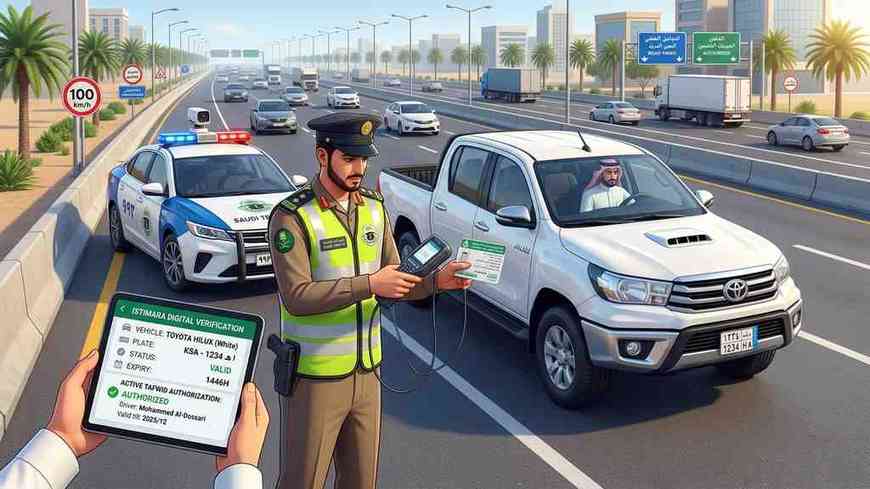
Regular traffic police checkpoints operate on Saudi highways. If you drive a friend's, colleague's, or company's sponsor's (kafeel) car and fail to show a digital Tafweed to police, the car can be directly confiscated at the traffic yard. The main benefits of having a Tafweed:
Ensuring legal accountability: When Tafweed is active, the driver is directly legally responsible during an accident or law violation, which protects the innocent car owner from unwanted hassle.
Fine distribution protection: If any speed or mobile phone violation is caught by a Saher camera while driving, the fine is automatically transferred to the driver's Iqama. To learn fine-related rules, you can see our Saudi Traffic Fine Check and Efaa Discount Guide.
Insurance claim settlement: Tafweed is extremely important for getting compensation in a road accident. Otherwise, the insurance company can reject the unregistered driver's compensation claim.
2. Preconditions for a Tafweed Application
To successfully complete Tafweed through Absher, both the car owner and driver must meet certain minimum government conditions:
Active Absher account: Both the owner and driver must have an active and biometrically verified Absher account. To learn the account opening method, read our Absher Account Registration and Fingerprint Guide.
Valid driving license: The person being authorized must have a valid driving license approved by Saudi traffic authorities. You can learn details of the steps to get a license from the Saudi Driving License and Dallah School Guide.
Valid Istimara and car insurance: The car's registration card (Istimara), Fahas (periodic motor inspection), and the mandatory third-party or comprehensive insurance term must be active.
Zero outstanding fines: The car owner or the person being made the driver must not have any unresolved traffic fine outstanding.
3. Internal Tafweed vs. International Tafweed
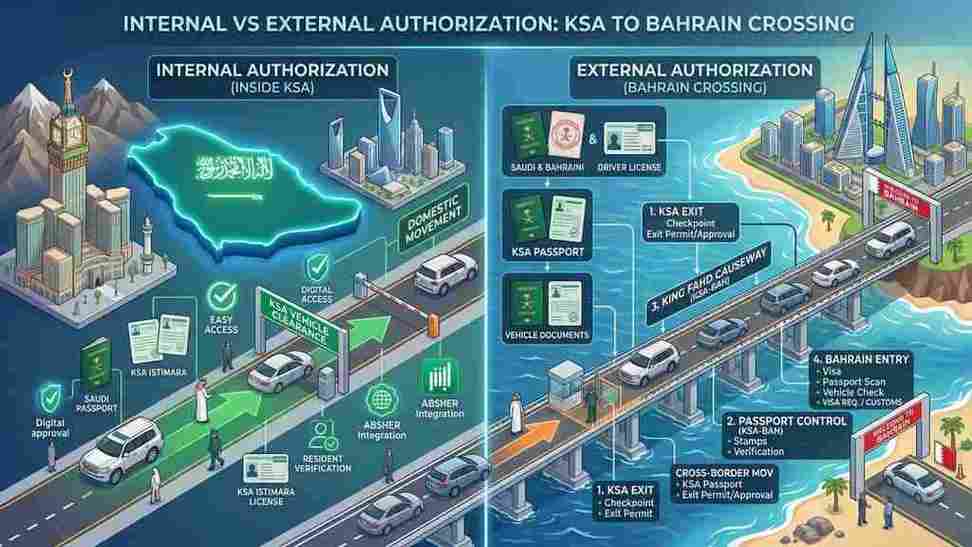
Based on need, mainly two types of driver authorization services are available on the Absher system:
Internal Authorization: This authorization applies for driving in various internal provinces and cities of Saudi Arabia. Its maximum term can generally be set up to 6 months. No government fee applies to this.
External Authorization: This is needed for driving a car from Saudi Arabia to travel to neighboring GCC countries such as Bahrain, UAE, Qatar, or Kuwait. In this case, the driver's passport, an effective exit re-entry visa, and valid motor insurance for both countries are mandatory.

4. Step-by-Step Process for Creating a Tafweed on Absher
The car's original owner will complete the following steps from their own Absher portal:
Absher login: Log into the 'Absher Individuals' portal with your national ID or Iqama number and OTP.
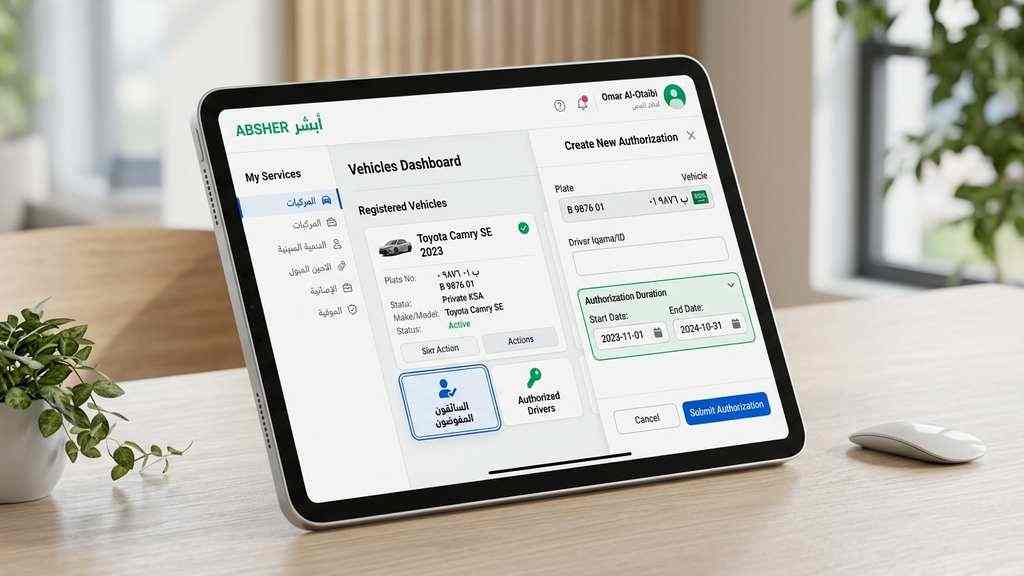
Vehicles section: From the main dashboard, select 'Vehicles Services' and click on the 'Authorized Drivers' menu.
Vehicle selection: If you own multiple cars, select the one for which you will issue the Tafweed.
Driver information input: Type the driver's 10-digit Iqama number and date of birth. Then set the authorization's start date and end date from the calendar.
Send request: Confirm the terms and submit the application, and a request will go to the driver's Absher.
Driver's consent (Acceptance): As soon as the driver enters their own Absher app and clicks 'Accept' on the pending request in the 'Vehicle Authorization' section, the Tafweed will instantly become active.
5. Tafweed Cancellation and Term Expiry
When the Tafweed term ends, it automatically deactivates. However, if the work is finished or the driver changes jobs, the owner can enter the Absher dashboard at any time and cancel the Tafweed (Cancel Authorization) with one click. Similarly, the driver can also apply to withdraw from the Tafweed responsibility at any time.
6. Tafweed for Commercial and Institutional Vehicles (Muqeem Portal)
The regular Absher portal does not apply for commercial vehicles of a company, supplier establishment, or commercial establishment. For institutional vehicle driver authorization, the Muqeem Business platform must be used. The establishment's HR or approved representative logs into Muqeem, tags the vehicle to the employee's Iqama number, and generates an official Tafweed certificate. For goods transport or long-distance commercial trips, showing this printed and digital copy to Transport General Authority (TGA) inspectors is mandatory.
7. Common Mistakes Related to Tafweed and Precautions for Expatriates
Expatriates often fall into complications due to certain careless mistakes when driving a car in Saudi Arabia:
Driving with an expired Tafweed: Once the authorization's specific date passes, it is automatically cancelled from the system. So before going on a long-distance trip, one should re-verify whether the term is active on the Absher app.
License category mismatch: The driver's driving license must be of the category (private or public) of the vehicle being driven. A Tafweed for driving a heavy commercial vehicle with a light license is legally void.
Fahas and insurance term: If the car's motor insurance term has expired, a police case can occur despite Tafweed approval, and the driver may be ordered to pay complete personal compensation in the event of an accident.
Regularly keep an eye on our Saudi Driving and Traffic Safety Center for legal awareness and license information for expatriates.
7. Official Tafweed Steps for Letting a Friend or Colleague Drive Your Car Without Ownership Change
If a personal private car or a company pickup van is registered under your own name in Saudi Arabia, but another colleague, friend, or driver regularly drives it, it is legally mandatory to officially complete a 'Tafweed' (Driver Authorization). Without Tafweed, the car can be confiscated at a traffic police check on the road, and the driver can be taken to the police station on suspicion of illegal possession.
Method for doing Internal Authorization on Absher:
The car's original owner will log into their own Absher account. Enter the 'Vehicles Services' -> 'Vehicle Management' option. Select your car from the list and press the 'Issue Authorization' button. Provide the authorized driver's 10-digit Iqama number and date of birth. Set the authorization term (maximum 6 months or 1 year) and submit. After this, the relevant driver must log into their own Absher account and 'Accept' this request within 24 hours. As soon as the driver accepts, the Tafweed becomes effective in the digital system.
8. International Tafweed: Driving a Saudi Car to Visit Bahrain, Kuwait, or Qatar
Many expatriates residing in Saudi Arabia want to cross the King Fahd Causeway to visit Bahrain or travel to Qatar or Kuwait by land border for a holiday or with family. If you want to cross the international border with your own or your company's Saudi-registered car, an ordinary Tafweed is not enough; 'International Authorization' (Tafweed Khariji) is needed for this.
Special conditions for international Tafweed:
If the car owner is a bank or a leasing company, a No Objection Certificate (NOC) and special border authorization must be obtained from the relevant financial institution. Both the driver's Iqama term and driving license must have at least 3 months of validity remaining. Upon reaching the border gate, a mandatory temporary border insurance policy must be purchased from Bahrain's or the relevant country's motor insurance booth. For a company car, a no-objection letter from the owner, certified by the Chamber of Commerce, must be uploaded to the Absher system.
9. Risk of Accident and Insurance Claim Cancellation When Driving Without Tafweed
The most dangerous situation arises when a sudden accident occurs on the road while driving someone's car without Tafweed. According to the policy of the Saudi Insurance Commission (Najm), if a car is involved in an accident and it is found that the driver has no valid Tafweed in their name, the insurance company can instantly reject all compensation claims.
As a result, 100% financial compensation — which can sometimes be up to hundreds of thousands of Saudi riyals — must be paid personally from the driver's and car owner's own pockets. If unable to pay compensation, the court can issue a travel ban on the driver, and the final ruling can even lead to jail. So never take a Saudi citizen's or colleague's car onto the road without Tafweed.
Method for Cancelling Tafweed and What to Do After the Set Term Ends
The car's original owner can cancel the Tafweed (Cancel Authorization) through Absher at any moment before the authorization term ends, if they wish. If the colleague changes jobs and leaves, or a specific trip ends, it is wise to immediately withdraw the Tafweed.
Rules for cancelling Tafweed:
The car owner enters Absher and goes to the 'Vehicle Management' -> 'Active Authorizations' menu. Press the 'Cancel Authorization' button next to the specific driver's name and confirm with OTP. As soon as it is cancelled, the digital permit will be erased from the driver's Absher, and in the traffic police's central system the car will return under only the original owner. If the specific term (such as 3 months or 6 months) passes naturally, the Tafweed automatically deactivates without any fee or fine.
Does the Tafweed Recipient's Traffic Fine Fall on the Car Owner?
According to Saudi Traffic Police's revised rules, if a valid electronic Tafweed is active on a car, all speed limit violations or signal disobedience fines caught by Saher camera during the authorization period are automatically added to the driver's personal Iqama ID. No point or fine is imposed on the car's original owner's record. So doing Tafweed before giving a car to a trusted friend or family member is the most effective legal step for the owner's own protection.
Frequently Asked Questions (FAQ)
Yes, according to traffic law, driving a car without the owner's digital Tafweed can result in the car being confiscated at a checkpoint and a fine of 500 to 900 riyals.
Any traffic fine from a Saher camera or police during an active Tafweed automatically falls on the authorized driver's Iqama, not on the original car owner.
To cross the Saudi border, 'External Authorization' or international Tafweed must be obtained from Absher, and the driver must have a valid passport and re-entry visa.
Smart Digital Expatriate Solutions for Saudi Arabia
Access instant Iqama checking, official labor contract validation, live Riyal exchange rates, and emergency consular services in the palm of your hand.
Install Probashi App Free